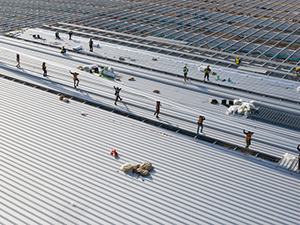
A metal roof is one of the most durable commercial roofing options available, but durability is not the same as invincibility. Montana’s climate tests every material on a building, and metal roofing is not exempt. At Flag Ship Foam & Coatings, we restore and protect commercial metal roofs across Montana, and we see the same weather-driven failure patterns repeat on buildings that were never treated after installation. Call us at 208-946-3031 to find out where your metal roof stands.
Belgrade sits in the Gallatin Valley, where commercial and agricultural buildings deal with a full range of punishing conditions. Chinook wind events bring rapid temperature swings in winter. Summers are hot and dry with high UV intensity. Snow loads in a hard winter put real mechanical stress on roof panels and fasteners. An uncoated metal roof absorbs all of that without protection.
Metal Roof Performance Under Extreme Weather Conditions
An uncoated metal roof starts losing performance from the day it is installed. The degradation is slow at first, but Montana’s climate accelerates it in ways that are not always visible from the ground. Surface oxidation, fastener fatigue, and coating breakdown each follow their own timeline, and they often converge around the same point in a roof’s life.
The performance limits of an uncoated metal roof show up in predictable ways: active leaks at fastener points, rust staining along seams, and oil-canning panels fatigued from years of thermal movement. By the time those signs appear, the damage has been developing for seasons. Catching the process earlier extends the roof’s life and avoids replacement.
What Montana’s Temperature Swings Do to a Metal Roof

Metal expands in heat and contracts in cold. On a large commercial or agricultural roof in the Gallatin Valley, that movement is significant across the full length of every panel. A Chinook event in January can push temperatures from below zero to above 50 degrees Fahrenheit within hours. The metal roof moves with that swing, and every fastener, seam, and penetration takes the stress of that movement.
Over years of Montana temperature cycling, that movement fatigues panel connections and the structure beneath them. Fastener holes elongate as panels shift. Sealant at laps and penetrations cracks and loses its bond. The roof develops micro-pathways that water finds during the next rain event, and those pathways widen if nothing seals them.
How UV and Moisture Work Against an Uncoated Metal Roof
Montana’s elevation means higher UV intensity than most building owners account for. UV radiation breaks down the protective coating on painted metal panels faster at altitude. Once the factory finish starts chalking and fading, the bare metal beneath is exposed to direct oxidation. Rust does not start on the surface. It starts where the coating has thinned or cracked, typically along panel edges, fastener heads, and cut ends.
Moisture compounds the UV damage. Morning condensation, snowmelt, and rain keep the surface wet repeatedly all year. On a roof where the coating has degraded, moisture accelerates oxidation significantly. High UV plus repeated moisture exposure is what moves a metal roof from cosmetic rust to structural rust faster in Montana than in lower-elevation environments.
The Fastener Problem Nobody Talks About
Galvanic corrosion at fastener points is the failure mode most building owners never see coming. The steel panel above looks fine. The fastener itself, exposed to trapped moisture at the panel interface, corrodes from the inside out. The first sign is a rust stain running down the panel below the fastener head, by which point the corrosion is already well advanced.
A large commercial metal roof in Belgrade has hundreds or thousands of fastener points, each a potential failure location. A Conklin MR System restoration encapsulates the entire fastener field under a seamless, fully adhered coating that cuts off the moisture driving galvanic corrosion. It is the step conventional paint programs miss entirely.
Protect Your Metal Roof
Every metal roof has a performance window, and Montana’s climate shortens it for buildings that were never treated after installation. At Flag Ship Foam & Coatings, we restore commercial and agricultural metal roofs across Belgrade, MT using Conklin MR Systems built to stop the weathering process and extend roof life by decades. Call us at 208-946-3031 to schedule a free inspection and find out what your metal roof actually needs.
FAQ
How long does a metal roof last in Montana?
An uncoated metal roof typically lasts 20 to 30 years in Montana. A properly restored and coated system can extend that by 15 to 20 years beyond the original lifespan.
Does a metal roof need maintenance in cold climates?
Yes. Freeze-thaw cycling, fastener fatigue, and UV degradation all require periodic inspection and treatment to prevent early failure in cold, high-elevation climates like Montana.
What causes rust on a commercial metal roof?
UV breakdown of the factory coating exposes bare metal, and repeated moisture contact then accelerates oxidation at those unprotected areas, particularly around fasteners and panel edges.
Can a damaged metal roof be restored instead of replaced?
Yes. As long as the structural integrity of the deck and panels is sound, a Conklin MR System restoration can seal, waterproof, and extend the roof’s service life without a full replacement.