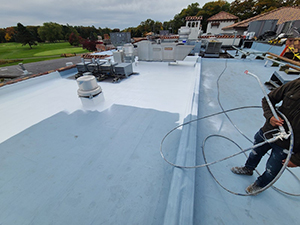
Commercial property owners in Moscow, ID managing aging TPO roofing systems frequently face the same question: repair, restore, or replace? Full membrane replacement is the most expensive path and not always the necessary one. TPO restoration offers a cost-effective middle ground that can extend roof service life significantly, but it is not the right solution for every roof.
The experts at Flag Ship Foam & Coatings are here to help you maximize your TPO roofing investment. Call 208-946-3031 today to schedule your consultation.
Is Your Roof a Candidate for TPO Restoration?
Understanding what makes a TPO roof a strong restoration candidate, and what disqualifies one, helps property owners make informed decisions before committing to either path.
TPO restoration is a process of renewing an existing thermoplastic polyolefin membrane through surface preparation, targeted repairs, and application of a compatible fluid-applied coating system. Unlike replacement, restoration preserves the existing membrane as the foundation of the renewed system rather than tearing it off and starting over. The coating bonds to the cleaned and prepared TPO surface, sealing existing vulnerabilities, restoring reflectivity, and providing a new waterproofing layer backed by a manufacturer warranty. The result is a roof that performs comparably to a new installation at a substantially lower cost.
Signs Your TPO Roof May Be a Good Restoration Candidate
Surface Chalking and Faded Reflectivity
TPO membranes are valued in part for their white reflective surface, which reduces solar heat absorption and lowers cooling loads. Over time, UV exposure causes the surface to chalk and lose reflectivity. A roof showing significant surface chalking, but otherwise sound membrane integrity is often an ideal restoration candidate, because the coating system restores reflective performance while also renewing the waterproofing layer.
Minor Seam Lifting and Edge Separation
Seam and termination issues are among the most common TPO deficiencies and are addressable within a restoration scope when they are isolated rather than widespread. Lifted seam edges and minor termination separations can be repaired with compatible TPO tape and adhesive during the surface preparation phase, before the coating is applied. A roof with localized seam issues and otherwise sound membrane condition is a strong candidate for restoration rather than replacement.
Surface Punctures and Minor Membrane Damage
Small punctures from foot traffic, hail impacts, or rooftop equipment contact are repairable within a restoration scope provided the underlying insulation has not been compromised by moisture intrusion. A qualified contractor will probe suspect areas during the inspection phase to confirm the insulation remains dry before proceeding. Isolated punctures on a roof with sound substrate conditions do not disqualify a restoration candidate.
Age Within the Restorable Window
TPO membranes are typically restorable when they retain sufficient thickness and structural integrity to accept and support a coating system. Most TPO roofs are strong restoration candidates between roughly 10 and 20 years of age, depending on installation quality, maintenance history, and exposure conditions. A membrane that has been maintained and inspected regularly is more likely to fall within the restorable window than one that has been neglected for an extended period.

What Disqualifies a TPO Roof from Restoration
Not every TPO roof is a viable restoration candidate, and a thorough inspection is the only reliable way to determine which category a specific roof falls into. Several conditions push a roof toward replacement rather than restoration.
Widespread moisture infiltration into the insulation layer is the most common disqualifying condition. When moisture has saturated insulation across a significant portion of the roof, the wet material must be removed and replaced before any new system is installed. If the affected area is large enough, the scope and cost of that remediation narrows the financial gap between restoration and full replacement considerably.
Membrane shrinkage that has placed tension on flashings and terminations across the entire roof is another disqualifying factor. Localized shrinkage can be managed within a restoration scope, but systemic shrinkage indicates the membrane has reached the end of its useful life and will continue pulling away from perimeter details regardless of what coating is applied over it.
Severely degraded membrane thickness, where UV exposure and weathering have reduced the TPO to a point where it can no longer provide a stable bonding surface, also moves the decision toward replacement. A coating applied to a membrane that is structurally compromised will not perform as designed and will not qualify for manufacturer warranty coverage.
TPO Restoration Professionals
Flag Ship Foam & Coatings provides TPO roof restoration and replacement services throughout Moscow, ID and the surrounding region. Their inspection process is thorough, their assessments are honest, and their restoration work is backed by manufacturer warranty coverage on qualifying roofs. If your commercial TPO roof is showing signs of age or recurring problems, contact Flag Ship Foam & Coatings at 208-946-3031 to schedule an assessment and find out whether restoration is the right path forward for your building.
FAQ
How long does a TPO restoration last?
A properly executed TPO restoration backed by a quality coating system typically carries a manufacturer warranty of 10 to 20 years depending on the system selected and the coating thickness applied. Roofs that receive regular maintenance and inspection after restoration consistently perform at the higher end of that range.
How does TPO restoration compare to full replacement on cost?
Restoration typically costs between 40 and 60 percent of full TPO replacement depending on roof size, condition, and the coating system applied. When the insulation is dry and the membrane retains sufficient integrity, restoration delivers comparable performance and warranty protection at a significantly lower investment, making it the preferred option for most qualifying roofs.